The Big Ten Lost Half Its Top-10 Ballot Support in Six Days
Indiana drove the collapse. Iowa and Oregon gained ground with individual voters, but the conference’s six ranked teams now conceal a much thinner leading group.
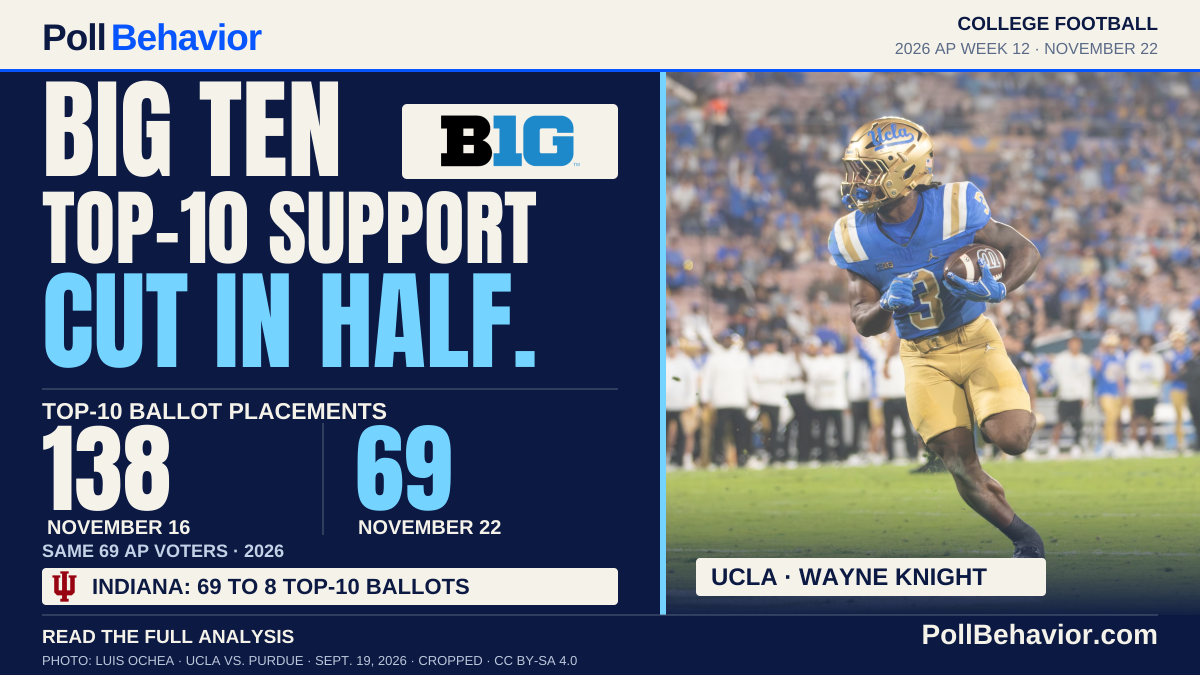
A week ago, every returning AP voter placed both UCLA and Indiana in the top 10. On Sunday, the Big Ten averaged just one top-10 placement per ballot, and Indiana accounted for almost all the damage.
Across the same 69 voters, the conference’s top-10 placements fell from 138 on November 16 to 69 on November 22. Indiana lost 61 of those places, UCLA lost nine and Oregon picked up one. That is the clearest measure of what happened to the Big Ten: a conference that still supplies six ranked teams has lost much of the confidence that made its leading group look formidable.
The losses came in different forms. UCLA fell 18–16 in triple overtime at Michigan, Indiana lost 27–24 in overtime at Washington, and Ohio State lost 31–28 at Nebraska. The ballots show three distinct consequences rather than one uniform conference penalty.
Indiana Lost the Confidence UCLA Kept
Indiana fell from No. 6 to No. 12, and every one of the 69 returning voters lowered the Hoosiers. All 69 had ranked them in the top 10 six days earlier; only eight still did on Sunday.
UCLA also fell six places, from fourth to tenth, but retained a far stronger position. Sixty voters kept the Bruins in the top 10, and all 69 kept them on their ballots. Sixty-eight lowered UCLA while one left it unchanged at No. 3.
Those identical six-place falls therefore conceal very different judgments. UCLA still has broad top-10 backing. Indiana’s support has settled mostly below that line, leaving the conference dependent on the Bruins for 60 of its 69 remaining top-10 placements.
Ohio State’s Survival Was Hardly an Endorsement
Ohio State remained ranked at No. 25, a result that drew immediate complaints in Sunday’s AP discussion. Its survival should not obscure the scale of the retreat: all 69 returning voters either lowered the Buckeyes or removed them, with 33 choosing removal and 36 keeping them somewhere from No. 18 through No. 25.
Nebraska’s position adds a sharper wrinkle. Of the 17 voters who ranked both teams, 16 put the Cornhuskers higher, yet Ohio State finished with 112 AP Points to Nebraska’s 90. The Buckeyes appeared on 36 ballots to Nebraska’s 31, and the complete distribution of placements and omissions produced the larger total. AP scoring awards 25 points for first through one for 25th, rather than choosing the winner of each pairwise comparison.
Ohio State kept a place in the poll while losing support on every returning ballot. The No. 25 label is a weak foundation for an argument that voters remained impressed.
The Winners Have Not Replaced the Leaders
The better news for the Big Ten sits below the top 10. Forty-seven voters raised Iowa, 48 raised Oregon, and 64 raised USC, with two more adding the Trojans after leaving them out. Iowa and Oregon nevertheless remained 13th and 14th in the aggregate poll; USC advanced to 15th.
Those are substantial improvements on individual ballots, but almost none reached the top 10. The conference’s winners strengthened its ranked depth without rebuilding the leading group that UCLA and Indiana had supplied.
The playoff stakes will be tested in the committee’s next release on November 24. Its November 17 rankings, which preceded these games, still had UCLA fourth, Indiana eighth, Oregon 13th, Ohio State 14th and Iowa 15th. The 2026 format guarantees the Big Ten champion a place; the pressure concerns the strength and number of its additional contenders.
Six ranked teams now flatter the apparent health of the conference’s national position. UCLA carries nearly all its remaining top-10 backing, Indiana has lost the consensus that supported its place among the leaders, and the improving teams have yet to fill that space. The Big Ten still has teams voters will rank. Its problem is finding enough teams they trust near the top.
Sources & Methodology
Calculations use the November 16 Week 11 poll and November 22 Week 12 poll, restricted to the same 69 returning voters. The earlier edition had 70 voters overall. One top-10 placement means one team in one voter’s top 10, so one ballot can contribute several placements. The official Big Ten standings identify the current conference membership. All 18 members were included in the placement count; only the teams shown supplied top-10 placements or appear in the current AP Top 25. Pairwise comparisons distinguish ballots containing both teams from ballots omitting one or both. Fan discussion identifies the public debate and does not establish voter motives. This is analysis of AP voting, not a prediction of the committee’s next ranking.
Download This Graphic
Big Ten Top-10 Support Cut in Half
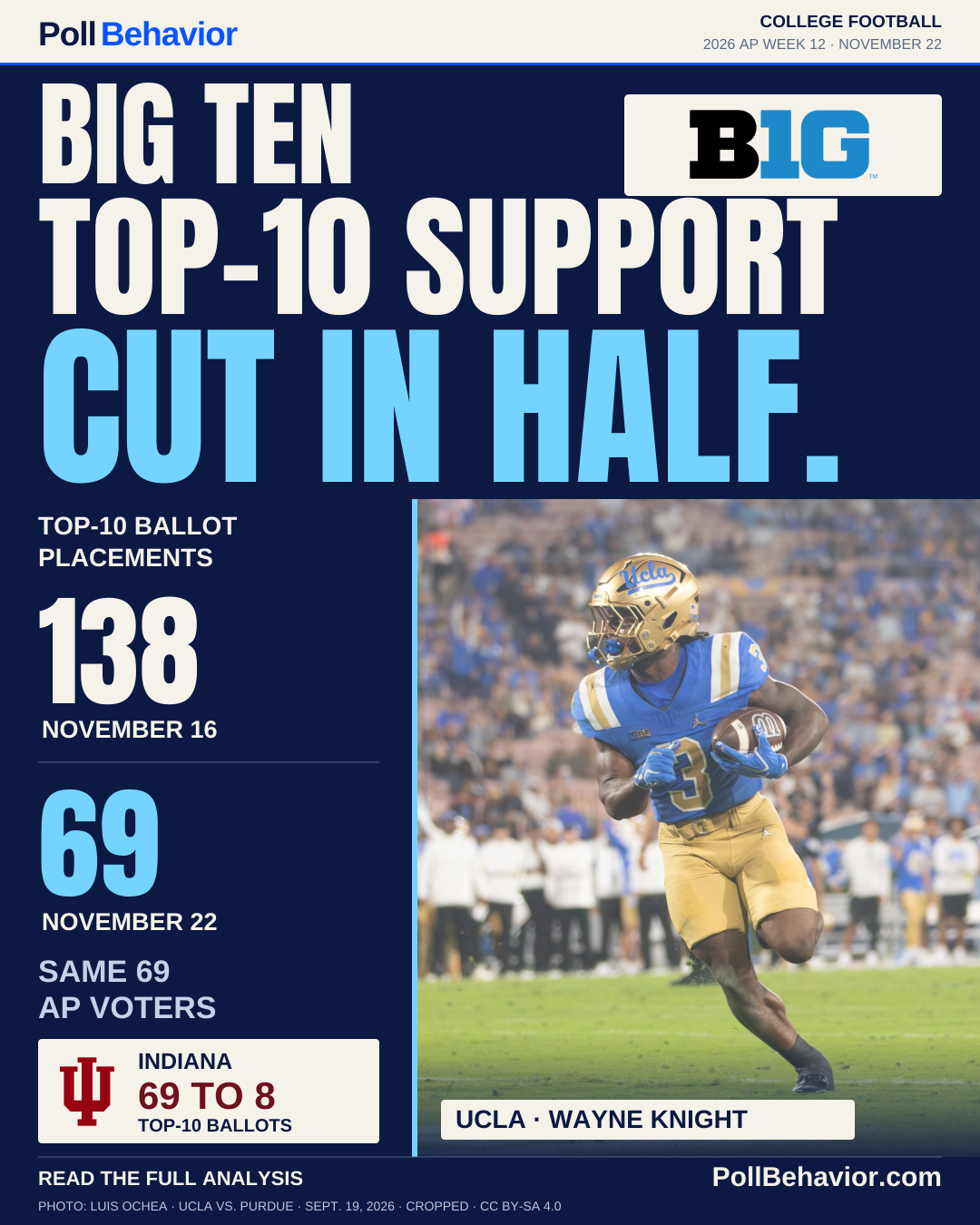
Graphic: Poll Behavior; photograph by Luis Ochea. Source. CC BY-SA 4.0 for adapted photograph and original composition; independent marks remain with their owners.. Luis Ochea, UCLA vs. Purdue, September 19, 2026. Proportionally scaled, cropped and shaded behind the player label. https://creativecommons.org/licenses/by-sa/4.0/. No endorsement implied.

Archive photo (September 19, 2026): Photo: Luis Ochea, UCLA vs. Purdue, September 19, 2026.. CC BY-SA 4.0. Proportionally scaled, cropped and shaded behind the player name label. Original photograph retained unchanged. Adapted composition CC BY-SA 4.0; independent school and conference marks remain with their owners. No endorsement implied.
Graphic: CC BY-SA 4.0. School and other third-party marks remain with their owners.