The CFP Ranks Nine SEC Teams Higher Than the AP Poll
Texas has three wins over the committee's Top 25. LSU has none. Those differences matter when assessing a ranking that puts unbeaten UCLA behind two two-loss SEC teams.
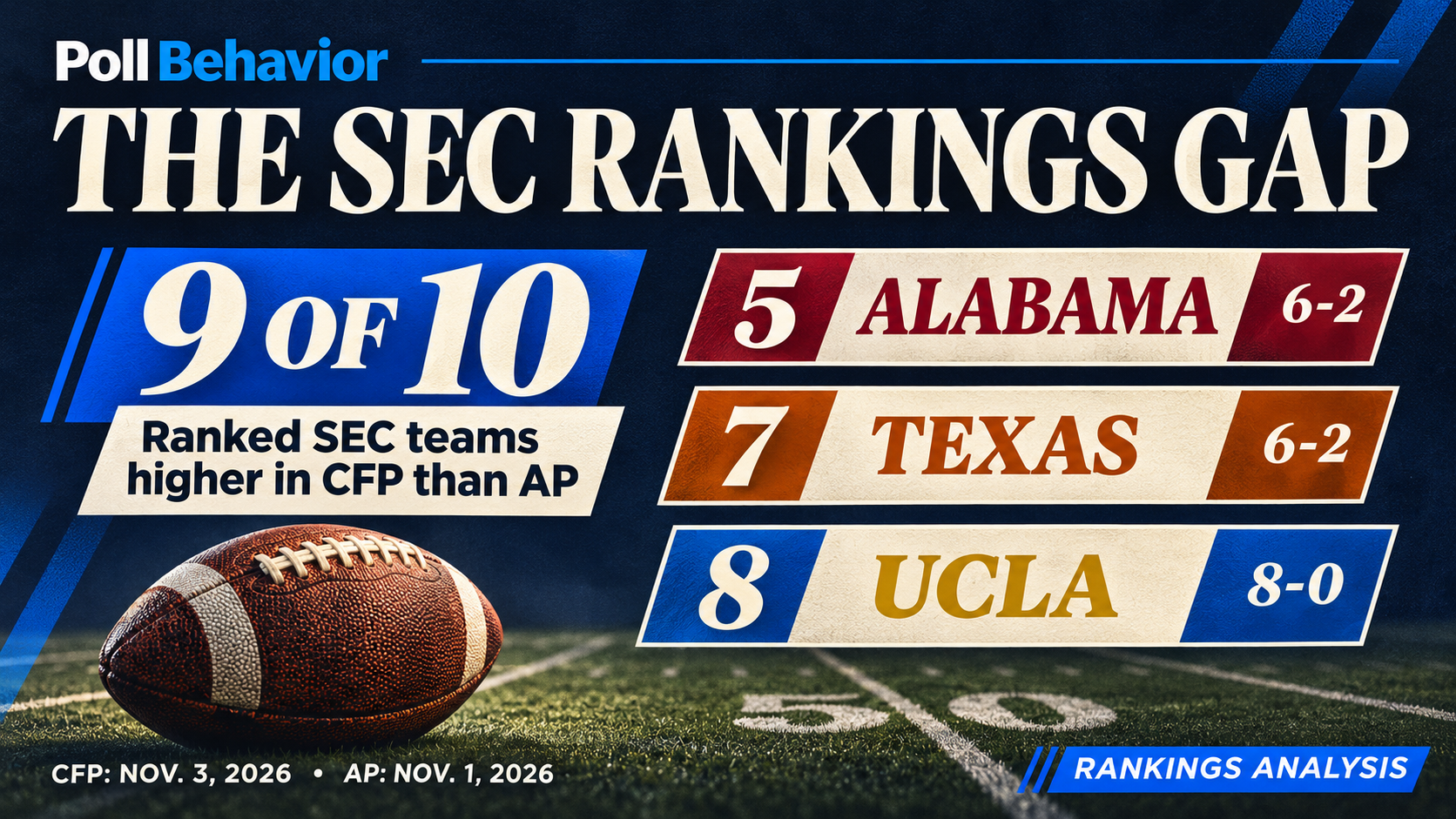
Nine of the SEC's ten ranked teams sit higher in the first College Football Playoff rankings than in the November 1 AP poll. Georgia, second in both, is the exception. None sits lower.
That pattern puts the committee's choices under scrutiny, especially with 8-0 UCLA eighth behind two-loss Alabama and Texas. But the AP poll is another judgment, not an objective answer key. Both lists include ten SEC teams. The disagreement concerns where those teams belong, and the strongest test is what they have accomplished.
Texas, Alabama and LSU offer substantially different cases. Treating them as interchangeable two-loss teams obscures why some placements have a convincing defense and others need a fuller explanation.
Texas and Alabama Have Different Arguments
Every ranked-opponent reference below uses the November 3 CFP Top 25, with games through October 31. It does not use an opponent's ranking at kickoff. That keeps the comparisons consistent, although using the committee's own list to evaluate its decisions is not an independent measure of team quality.
Texas beat Ohio State 24-23, won 20-17 at Tennessee and defeated Ole Miss 34-27. The Ohio State victory matters particularly: the Longhorns' argument includes a win outside their conference, rather than relying entirely on SEC teams validating one another.
Alabama has two current ranked wins, with greater margins: 45-17 at Kentucky and 49-18 against South Carolina. The road victory over Kentucky is substantial evidence for Alabama's placement. It is also a different argument from Texas's three ranked wins.
Asked directly about Alabama above UCLA in his November 3 media conference, chair Hunter Yurachek cited those victories and said seven of Alabama's eight opponents had records of .500 or better. He also credited Alabama's win at Mississippi State based on the Bulldogs' strength at that point, saying the quarterback's subsequent season-ending absence would not erase its value. That contextual definition of a quality win extends beyond the current Top 25 used in this article's table.
His description of Mississippi State as being at “full strength” needs qualification. Rick Cleveland's October 3 reporting for Mississippi Today said quarterback Kamario Taylor entered the Alabama game with a lower-leg injury and left in a protective boot. Mississippi State announced his season-ending foot injury on October 27. Those accounts distinguish playing from being fully healthy; they do not erase Alabama's 56-23 victory.
UCLA has beaten everyone it played, including a 17-15 road win at Oregon. That is its only current ranked victory. The Bruins have fewer high-end wins, but no defeat to offset them. Texas lost to unranked Oklahoma and No. 24 Florida; Alabama lost to Georgia and Tennessee. Tougher opposition helps explain the committee's preference without making those losses disappear.
Yurachek also acknowledged that UCLA and third-ranked Utah had nearly identical schedules and resumes, including one current ranked win apiece. He said the committee preferred Utah after watching both teams, citing its offensive balance and defense. That is an explicit preference based on game film, and a non-SEC example of the committee separating teams with similar results.
Alabama's position creates another test within the SEC. Tennessee beat the Tide 26-10, yet ranks eight places below it. Both are 6-2. Alabama's wins at Kentucky and against South Carolina give it achievements Tennessee lacks, while Tennessee lost to Texas and South Carolina. Head-to-head need not settle every comparison, but a decisive result requires a substantial explanation when the losing team finishes that far ahead.
In his ESPN interview posted by the CFP, Yurachek confirmed that Alabama and Tennessee were never in the same comparison group during the ranking process. That describes the procedure. It does not settle whether an eight-place separation gives adequate weight to their game.
LSU and Texas Tech Pose the Harder Comparison
LSU's placement immediately above Texas Tech is the clearest challenge to a simple wins-based defense of the rankings. The Tigers have one fewer victory, one more loss and no win over a team in this Top 25. Texas Tech has two.
The Red Raiders beat Houston 28-26 and Arizona 34-26. LSU's six victories came against Clemson, Louisiana Tech, Texas A&M, McNeese, Mississippi State and Auburn. None made the committee's list.
The losses provide meaningful counterevidence. LSU lost 32-24 at Ole Miss and 35-34 in overtime at Kentucky, both ranked opponents on the road. Texas Tech lost 37-24 at unranked Cincinnati. The Tigers have avoided the weaker loss, and close defeats against strong opponents can support a favorable assessment of how well they have played.
In the media conference, Yurachek pointed to Texas Tech's Cincinnati loss, LSU's losses to the current Nos. 6 and 10, and the Tigers' decisive victories, including Clemson. His explanation puts the quality of defeats and dominance against unranked opponents at the center of this comparison.
There is also independent support for a schedule difference. Brian Simmons's November 2 ratings, covering games through November 1, rank LSU's played schedule 16th and Texas Tech's 52nd among 266 Division I teams. That is one model, not a reconstruction of the committee's reasoning or a measure of what either team earned by winning. Its schedule comparison supports the defense of LSU; it does not answer why that difficulty outweighs Texas Tech's additional win and two ranked victories.
Yurachek's account explains the choice, but the tradeoff deserves scrutiny. LSU's better losses and dominant wins outweighed Texas Tech's additional victory and success against two teams the committee itself ranks. That is a substantial preference for how a team played over whom it beat.
Three Losses Demand More Than Schedule Credit
South Carolina, Oregon and Florida have each lost three of eight games, or 37.5%. That is a major weakness this early in the season. Their inclusion gives repeated defeats less weight than a record-first ranking would, and strong schedules alone cannot justify it: the committee must also identify what those teams won.
Each has two current ranked victories. Florida's are particularly strong: 52-28 over Ole Miss and 27-24 at Texas. South Carolina won 38-19 at Florida and 27-24 against Tennessee. Those are concrete achievements, not merely credit for facing difficult opponents.
The losses still deserve close inspection. Florida lost all three to currently ranked teams, by 28, 19 and 19 points. South Carolina lost to unranked Mississippi State, was beaten by 31 at Alabama and lost in overtime to Kentucky. Neither resume becomes convincing merely by attaching a conference label to it.
Oregon prevents describing three-loss inclusion as an exclusively SEC allowance. The Ducks beat Boise State and USC, but lost to unranked Oklahoma State and Illinois as well as UCLA. They also beat 6-2 Northwestern 34-26, a direct reason to prefer Oregon in that particular comparison. That result does not settle their standing against every better-record team outside the rankings.
The CFP's November 2 explanation of its conference-strength enhancement emphasizes schedule differences within a conference. It does not publish an automatic SEC bonus or a numerical weighting formula. That presentation cannot by itself explain these placements.
The strongest defense of the SEC's placements is specific victories, as Texas demonstrates. LSU's position depends more on the quality of its defeats and dominance against unranked opponents; Alabama's gap from Tennessee shows how the ranking procedure can weaken head-to-head consideration. Those are consequential choices about what counts as achievement. Three defeats should likewise impose a substantial burden, even on teams with impressive wins. The test for future rankings is whether those judgments remain consistent when a different team or conference benefits.
Reporting note: Poll Behavior requested comment from the CFP on November 4. The request remained unanswered as this article was prepared. This article will be updated with any substantive response.
Download This Graphic
The SEC Rankings Gap
Graphic: Poll Behavior (AI-assisted). Source. Original artwork prepared for Poll Behavior; publisher-authorized use. AI-generated editorial graphic using the November 3 CFP and November 1 AP rankings. Landscape cover; the same PNG is supplied for both download options.