Boise State’s No. 24 Shows Why G6 Access Still Depends on the Committee
The Broncos sit at the bottom of their AP ballot range, while New Mexico remains outside CFP’s Top 25. Expansion adds opportunities next season, but keeps one guaranteed G6 place.
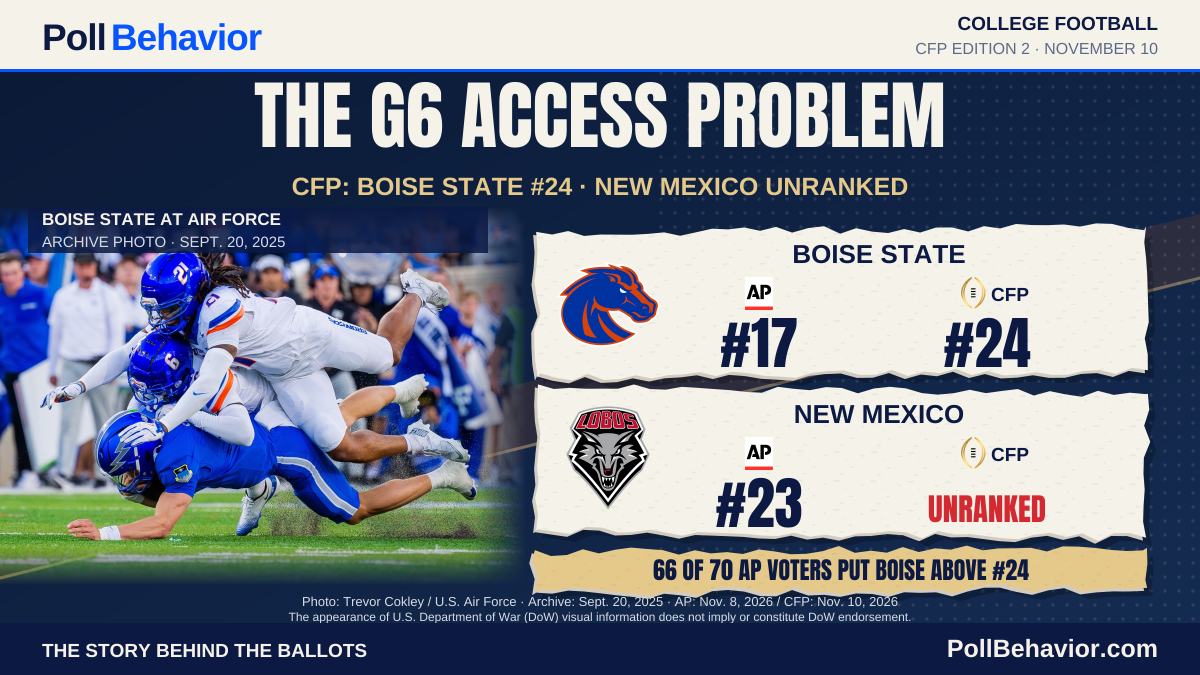
All 70 AP voters ranked Boise State this week. Sixty-six placed the Broncos higher than the College Football Playoff committee did.
Boise’s No. 24 CFP position matches its lowest placement on any AP ballot. Four voters put it there; the other 66 ranked it between 12th and 23rd. Together, those ballots produced AP No. 17.
New Mexico has a different boundary problem. The Lobos are AP No. 23, appearing on 65 of 70 ballots, but remain outside the committee’s Top 25. Both teams are 8–1. Boise is the only Group of Six team in the new CFP rankings.
Their treatment arrives one day after the announcement of a 24-team playoff beginning in 2027–28. The field will double, while the six conferences retain one shared guaranteed place. The committee’s evaluation will still determine how far another G6 contender can go through the at-large route.
Oregon Gives the Committee a Serious Counterargument
Boise’s seven-place gap between AP and CFP is the largest among teams ranked in both lists. Oregon, meanwhile, sits 16th in CFP and 18th in AP, putting it eight committee places ahead of Boise despite a 6–3 record.
There is a direct football reason to put the Ducks first: they beat Boise State 34–27 in Eugene on September 5.
AP voters nearly split on that order. Among the 69 who ranked both, 36 put Boise higher and 33 put Oregon higher. The remaining voter ranked Boise and omitted Oregon. Boise’s better aggregate AP rank therefore conceals considerable support for the head-to-head winner.
Oregon also has three victories over teams ranked in both current lists: Boise, USC and Ohio State. Boise has none. The Ducks’ latest addition was a 41–28 road win at Ohio State, another result that strengthened their case during the week the committee moved them from 23rd to 16th.
That comparison helps explain why two additional losses need not automatically put Oregon below Boise. It does not decide how much separation the results deserve. The AP ballots show a close argument over their order; CFP places them in substantially different parts of the Top 25.
Boise has supplied reasons for evaluators to look beyond its record, too. Before winning 64–38 at Colorado State, it beat Texas State 46–45 at home. The Broncos have won eight straight since the Oregon loss, but eight wins do not establish that every performance or opponent was comparable to those of a team from another schedule.
The substantive question is how the committee weighs those records across conferences. A broad accusation of G6 bias needs to account for Oregon’s direct win and additional ranked victories, just as a defense of the committee needs to explain the size of the separation.
New Mexico Is Outside the Comparison Entirely
New Mexico’s 31–3 win at Nevada added another victory without earning its first CFP ranking of the season. Its support in AP is broad: 65 voters included it, with placements ranging from 15th to 25th. Five left it out.
That establishes a meaningful disagreement at the boundary. The committee includes Missouri and Oklahoma State, both outside AP’s Top 25, while excluding New Mexico and AP No. 25 SMU.
New Mexico’s own record also needs the same scrutiny applied to Boise. The Lobos have no win over a team currently ranked in either system. Their only defeat came at Oklahoma, which is unranked in both. The absence of a currently ranked win leaves room for a schedule-based explanation of their position, even as AP’s 65 inclusions show how widely a different judgment is held.
The two G6 contenders are not interchangeable, either. Among the 65 AP voters who ranked both, 61 placed Boise above New Mexico and four reversed them. All five remaining voters included Boise alone. AP strongly prefers Boise within this pair while treating both as Top 25 teams.
More At-Large Places Still Require Higher Evaluations
The current 2026–27 playoff remains a 12-team competition. Its guaranteed qualifiers are the four Power Four conference champions and the highest-ranked team from the American, Conference USA, MAC, Mountain West, Pac-12 or Sun Belt. Seven remaining places are filled through the at-large order.
The G6 guarantee goes to the highest-ranked team from those leagues; it does not require that team to win its conference. It is also a floor for access, not a one-team limit. Another G6 team can qualify at large.
Next season’s format preserves those five guaranteed places and increases the at-large allocation from seven to 19. Those additional openings create a real opportunity for a second G6 entrant. Whether that opportunity becomes a berth still depends on where the committee places the team relative to the rest of the field. A Top 25 appearance alone does not guarantee selection, and automatic qualifiers can affect the at-large boundary.
The November rankings cannot tell us which teams the committee will select next season. They do show the evaluation problem expansion leaves in place. Boise has nearly unanimous AP support above its CFP position, and New Mexico has broad support for a ranking the committee has not given it. More available places can help both kinds of contender. For G6 access beyond the guaranteed representative, the decisive question remains whether those teams receive a ranking high enough to use them.
Sources & Methodology
The November 10 CFP comparison uses the official release and 70 complete November 8 AP ballots. Boise appears on all 70, ranging from 12th to 24th; New Mexico appears on 65, ranging from 15th to 25th. Pairwise comparisons count only voters ranking both teams, with omissions reported separately. NR is categorical and is never assigned a fictional No. 26.
Completed schedule records for Boise State, New Mexico and Oregon support the records, scores and ranked-win comparisons. Opponent ranks are the current November 8 AP and November 10 CFP positions, not rankings at kickoff. New Mexico’s Nevada game was played Friday, November 6, although some source URLs and UTC timestamps use November 7. Boise is a Pac-12 member in 2026; New Mexico is in the Mountain West.
Qualification rules were checked against the official selection protocol and November 9 expansion announcement. The article compares rules, not a simulated 2027 field using 2026 teams. No G6-specific explanation from the current chair was independently verified, and none is attributed here. The AP/CFP gaps document different judgments, not a demonstrated cause involving conference identity.
Download This Graphic
The G6 Access Problem
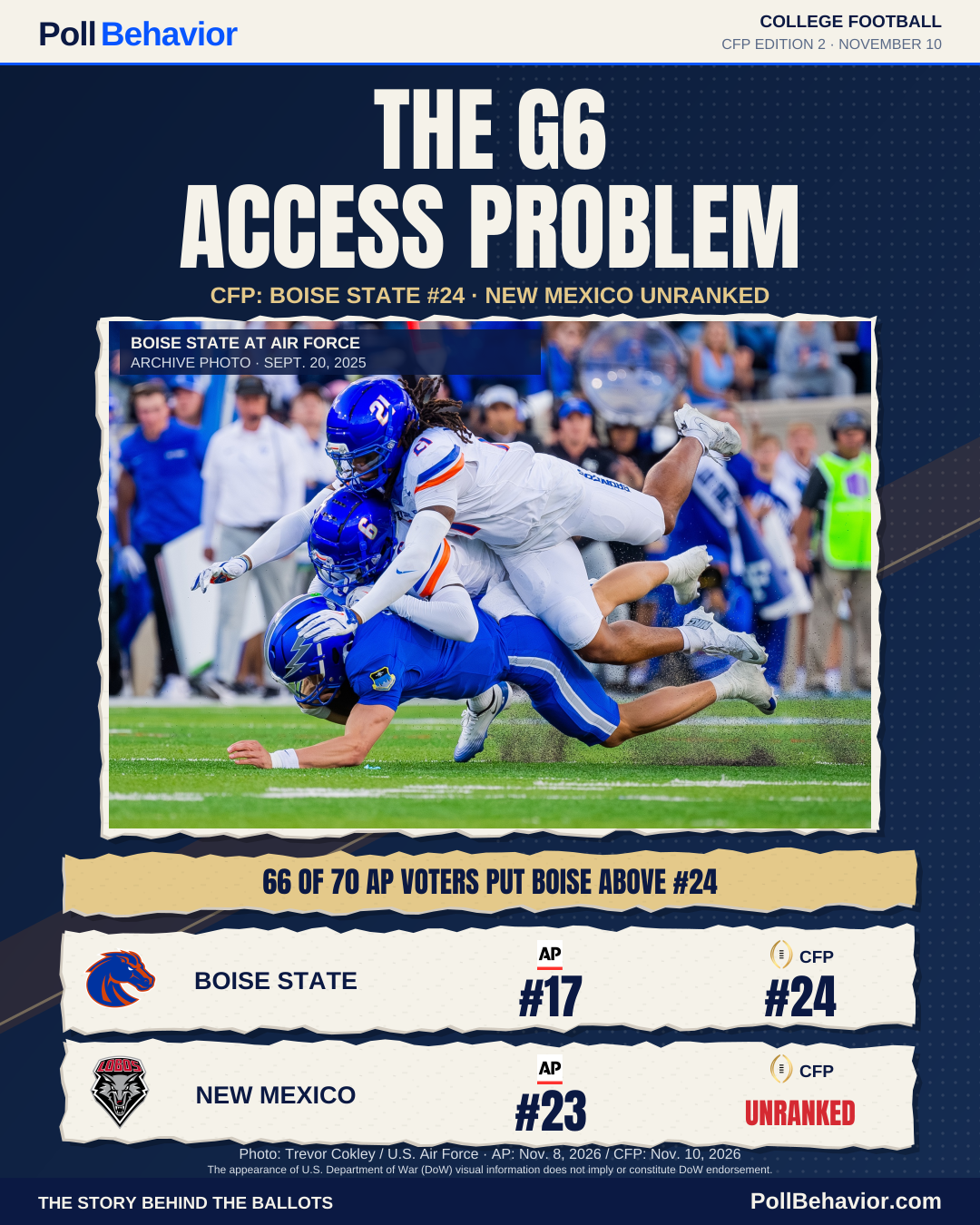
Graphic: Poll Behavior; photograph by Trevor Cokley / U.S. Air Force. Source. Photograph: U.S. government work, public domain in the United States; original Poll Behavior composition; school and ranking marks reserved.. Photo: Trevor Cokley / U.S. Air Force. Boise State at Air Force, September 20, 2025. Archive photograph, not current-season action. Proportional scaling/cropping and graphic framing; original photo pixels retained. The appearance of U.S. Department of War (DoW) visual information does not imply or constitute DoW endorsement.
Archive photo (2025-09-20): Photo: Trevor Cokley / U.S. Air Force. U.S. government work (public domain in the United States). Proportional scaling/cropping and graphic framing; original athlete and uniform pixels retained. The appearance of U.S. Department of War (DoW) visual information does not imply or constitute DoW endorsement.