Indiana’s Unchanged AP Rank Hid a Week of Falling Support
The Hoosiers stayed sixth in AP while 39 voters lowered them. That helps explain the direction of their CFP drop during a bye, while leaving its size open to challenge.
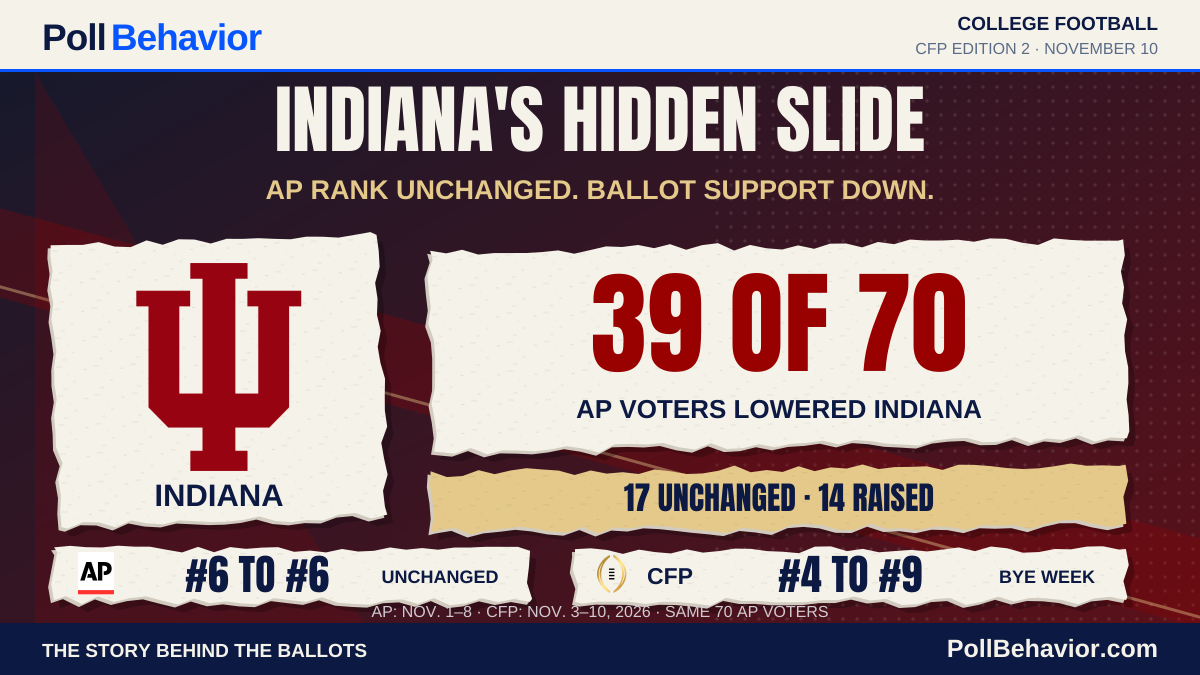
Indiana stayed No. 6 in the AP poll during its bye. Most of the voters who produced that ranking moved the Hoosiers down.
Thirty-nine of the same 70 voters lowered Indiana between their November 1 and November 8 ballots. Seventeen kept it in the same spot and 14 raised it. The unchanged team ranking concealed a loss of 70 points and a substantial shift toward UCLA.
That provides a useful comparison for the College Football Playoff committee’s decision Tuesday to drop Indiana from fourth to ninth. The committee made a more severe reassessment than AP’s final order suggests, but the underlying AP ballots were already moving in the same direction.
The distinction matters because Indiana did not add a loss. Its record remained 8–1 while other teams and the opponents already on its schedule continued playing.
UCLA Gained Ground on the Same Ballots
The biggest change in Indiana’s relative standing came against another Big Ten contender. UCLA led Indiana 36–34 on individual AP ballots a week earlier. This Sunday, the Bruins led 62–8.
| Individual AP Ballot Order | Nov. 1 | Nov. 8 |
|---|---|---|
| UCLA Ahead of Indiana | 36 | 62 |
| Indiana Ahead of UCLA | 34 | 8 |
These were the same voters, so the change can be traced directly. Twenty-six switched from Indiana ahead to UCLA ahead. Nobody switched the other way. Thirty-six kept UCLA first in that comparison, and eight kept Indiana first.
UCLA rose from fifth to fourth in the aggregate AP order while Indiana stayed sixth. Their points gap nevertheless grew from 27 to 166.
The arithmetic follows the AP scoring system: a first-place vote is worth 25 points, a second-place vote 24, down to one point for 25th. UCLA gained 69 points across the two editions; Indiana lost 70. Those changes widened the gap by 139 points without moving Indiana out of sixth.
The underlying choices were broader than a small adjustment from a few voters. Forty-seven raised UCLA, 17 kept it unchanged and six lowered it. Indiana’s movement ran mostly the other way. An aggregate rank tells readers where a team finished relative to the rest of the field; it can conceal considerable change in the support that put it there.
The Bye Did Not Freeze Indiana’s Résumé
Indiana’s completed schedule includes wins over Northwestern, Michigan and Minnesota. All three lost during the Hoosiers’ week off. Ohio State, the only team to beat Indiana, also lost, 41–28 to Oregon.
Those results gave evaluators new information about games Indiana had already played. They also gave other contenders an opportunity to improve their own records. Notre Dame beat Miami, Alabama won at LSU and UCLA won 34–20 at Minnesota.
The Minnesota game offered a particularly direct comparison. Indiana had beaten the Gophers 23–16 at home the preceding week. UCLA won by two touchdowns on the road. The results do not turn a ranking into a margin-of-victory formula, but they supply more evidence than the assertion that Indiana simply lost ground while doing nothing.
In an Associated Press account carried by WAKA, chair Hunter Yurachek attributed Indiana’s fall partly to the timing of its bye as other teams earned significant wins. The report also described his reference to UCLA’s performance against Minnesota when explaining the Bruins’ rise.
Indiana’s narrower wins were already part of its record before the bye. Four of its conference victories came by seven points or fewer: Northwestern, Nebraska, Michigan and Minnesota. The committee’s criteria call for evaluating schedules and common opponents without incentivizing margin of victory. A fair comparison must consider the opponents and circumstances, rather than treating a larger winning margin as an automatic entitlement to a higher rank.
The AP Evidence Still Stops Short of No. 9
The same ballots that document Indiana’s decline also show the limit of the agreement with CFP. Sixty-two AP voters placed the Hoosiers above ninth. Six put them ninth and two put them lower.
That leaves a substantial dispute over the size of the committee’s adjustment. AP voters moved decisively toward UCLA, yet almost nine in ten still placed Indiana higher than its new CFP position. The two observations can coexist: Indiana lost support during the bye, and the committee pushed it down further than most AP voters did.
Indiana also moved below three two-loss SEC teams in the committee’s order: Alabama, Texas and Tennessee. Its loss count is better, but its eight victories include no opponent currently ranked in either AP or CFP. Alabama has three such wins and Tennessee two. That comparison gives the schedule argument substance, while leaving the weight assigned to those wins and Indiana’s better record open to debate.
The next opportunity is USC’s visit on November 14. The Trojans are 15th in AP and 18th in CFP, so a victory would add a currently ranked opponent to a résumé that lacks one under either baseline.
The USC game can give Indiana evidence that neither a bye-week argument nor its unchanged AP rank supplies. Until then, the ballots support the direction of the committee’s reassessment while leaving its severity open to challenge. Voters increasingly preferred UCLA, but most still saw Indiana as better than the No. 9 team.
Sources & Methodology
Poll Behavior compared the same 70 voter IDs in its complete November 1 and November 8 AP editions, paired respectively with the November 3 and November 10 CFP releases. Both AP polls contain 1,750 placements and 22,750 points. Indiana fell from 1,446 to 1,376 points; UCLA rose from 1,473 to 1,542. Every voter ranked both schools in both editions. A relative-order switch compares the two schools within one voter’s ballot, not their aggregate ranks.
Current Indiana placements are compared with the committee’s published No. 9, not individual committee ballots. The dated CFP comparison preserves the relevant AP evidence. The public claim that this was the largest bye-week drop in CFP history has not been independently established and is not used here.
Completed ESPN schedule records verify Indiana’s games and the bye-week results for Northwestern, Michigan, Minnesota and Ohio State. Ranked-win counts use the November 8 AP and November 10 CFP positions, not game-time rankings. The chair’s explanation is attributed to published AP reporting; Poll Behavior did not interview him or independently review the recording. The article does not assign reasons to individual AP voters.
Download This Graphic
Indiana's Hidden Slide
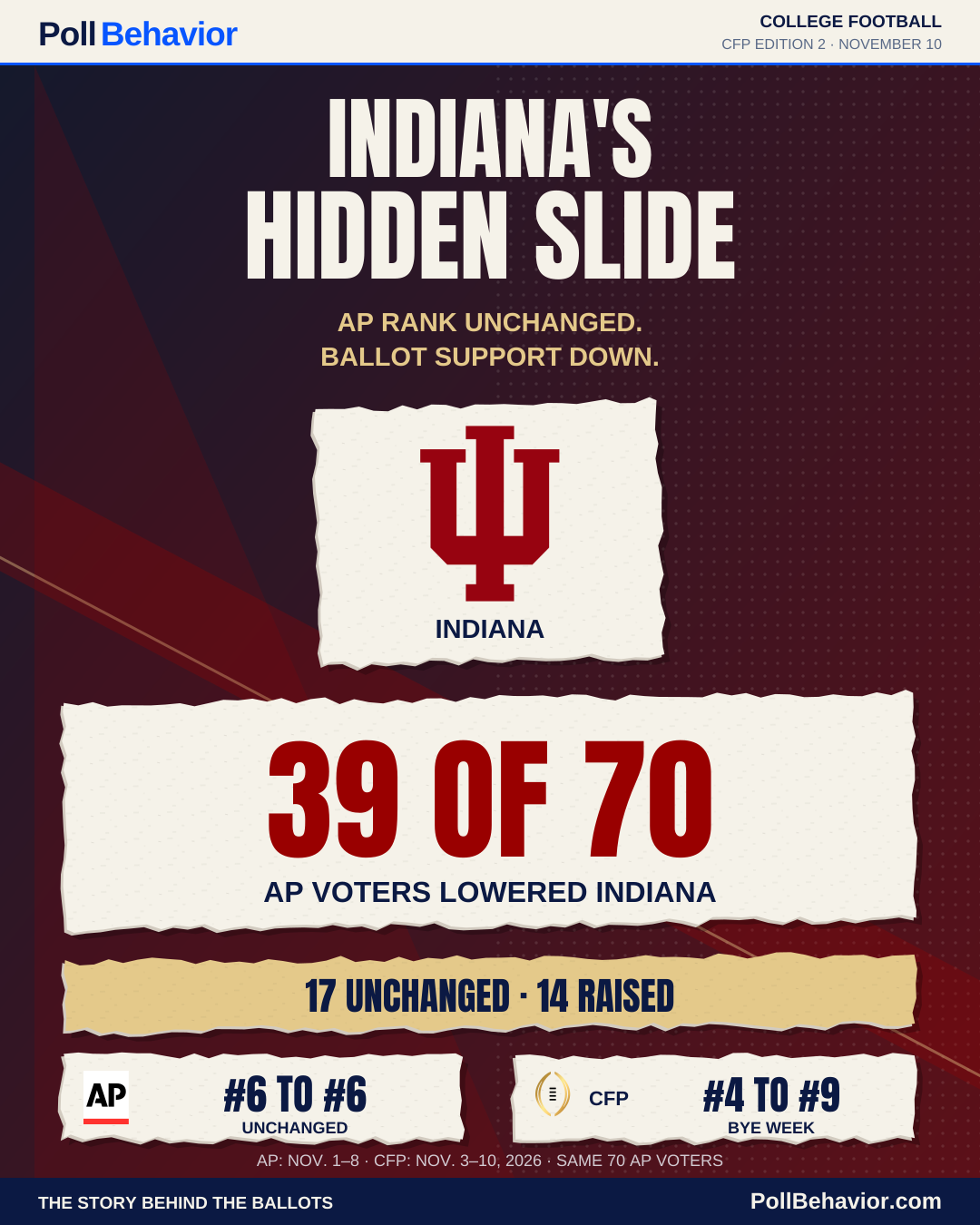
Graphic: Poll Behavior. Source. Original Poll Behavior composition; school, conference, AP and CFP marks remain with their respective owners.. Original source marks preserved. Native vector composition, Anton and Liberation Sans project fonts. No generated athlete photography.