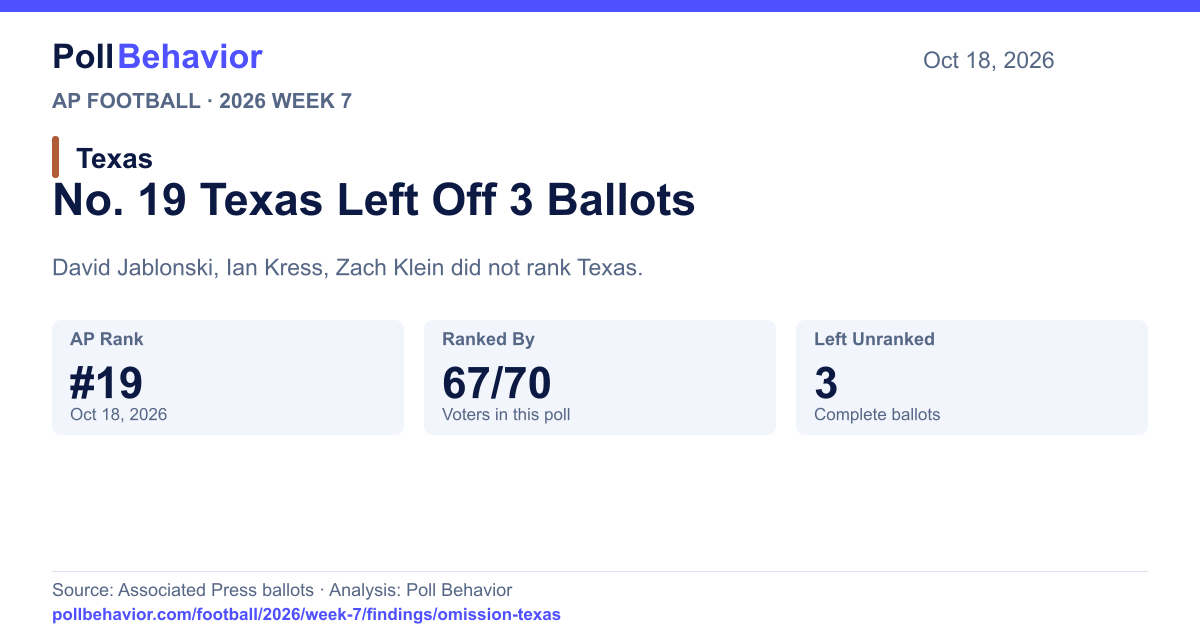
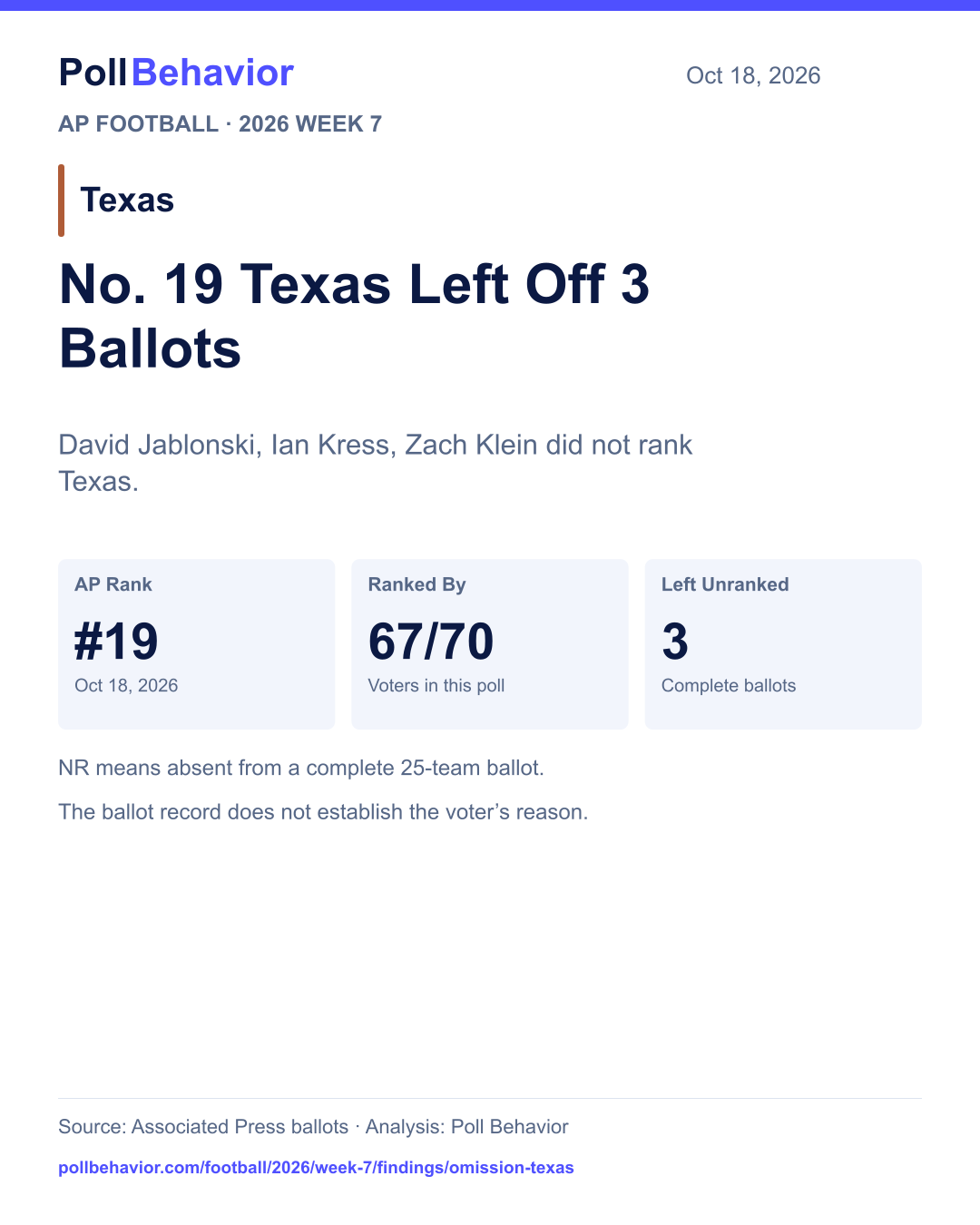
Texas
TexasReported Analysis · AP Football · Week 7
Texas Lost 931 Points as Every AP Voter Lowered or Omitted It
The Longhorns remain on 67 of 70 ballots. Most of their point loss came from voters who still ranked them.
Texas LonghornsTwo weeks after leading the AP poll with 61 first-place votes, Texas is No. 19 and has no top-10 votes. Its second consecutive loss brought a lower assessment from every member of the 70-voter panel.
Sixty-seven voters moved Texas down while keeping it ranked. Three left it out. The Longhorns lost 931 points between October 11 and October 18, with 872 of those points disappearing through lower placements on the ballots that still included them.
That is nearly 94% of the weekly loss. The three new omissions account for the other 59 points.
A Second, Much Larger Fall
Texas had already dropped from first to seventh after losing to Oklahoma. The October 18 AP report records another 12-place fall after the home loss to Florida.
| Poll Date | AP Rank | Points | Ballots Including Texas | Top-10 Votes |
|---|---|---|---|---|
| October 4 | 1 | 1,737 | 70 | 70 |
| October 11 | 7 | 1,371 | 70 | 66 |
| October 18 | 19 | 440 | 67 | 0 |
The first fall cost Texas 366 points. The second cost it 931. Its total has fallen by 1,297 points across the two polls, while its inclusion count has declined by just three.
The losses occurred during a broader upheaval that included five of the previous top seven teams falling on the same Saturday. Texas's movement shows how differently that upheaval could be expressed: the panel mostly kept the Longhorns in the Top 25 while removing all remaining top-10 support.
Lower Placements Accounted for 872 Lost Points
AP scoring gives a team one point fewer for each place it falls on a ballot, until an omission removes the points entirely. Matching each voter's October 11 and October 18 choices makes it possible to separate those effects.
The 67 voters who retained Texas collectively gave it 1,312 points a week earlier and 440 this week. Their lower placements account for the 872-point decline. The average rank among the remaining Texas voters is now 19.43, and their placements range from No. 12 to No. 25.
The three voters who omitted Texas had previously ranked it fourth, seventh and eighth. Those placements were worth 22, 19 and 18 points, respectively, for a combined 59. The calculation records each omission as zero points; it does not treat an unranked team as No. 26.
| Source of the Weekly Point Loss | Points | Share of the 931-Point Loss |
|---|---|---|
| Lower placements on the 67 retained ballots | 872 | 93.7% |
| Three new omissions | 59 | 6.3% |
No returning voter kept Texas in the same position or raised it. This was a panel-wide decline, extending well beyond the three ballots that removed it.
Still Included, Much Further Down
The remaining support is broad enough to distinguish this result from a mass departure from the poll: 67 voters still ranked Texas, and 44 placed it in their top 20. The losses have changed the level of that support much more than its reach.
The No. 19 ranking therefore reflects more than a few conspicuous omissions. Most of the damage came from the voters who retained Texas and moved it into the lower half of their ballots. The Longhorns still have near-universal inclusion, but the top-tier standing they held two weeks ago has disappeared across the entire panel.
Sources & Methodology
Figures were independently recomputed from the complete October 4, October 11 and October 18 AP editions. All three use the same 70 voter IDs. Point-loss categories compare each voter's actual adjacent ballots and sum to 931; percentages are rounded to one decimal.
AP's October 18 release supplies the Florida-loss context. Texas's preceding Oklahoma loss is documented in our Week 6 analysis and its linked official game record. The historical weekend comparison is supported by ESPN Research's account.